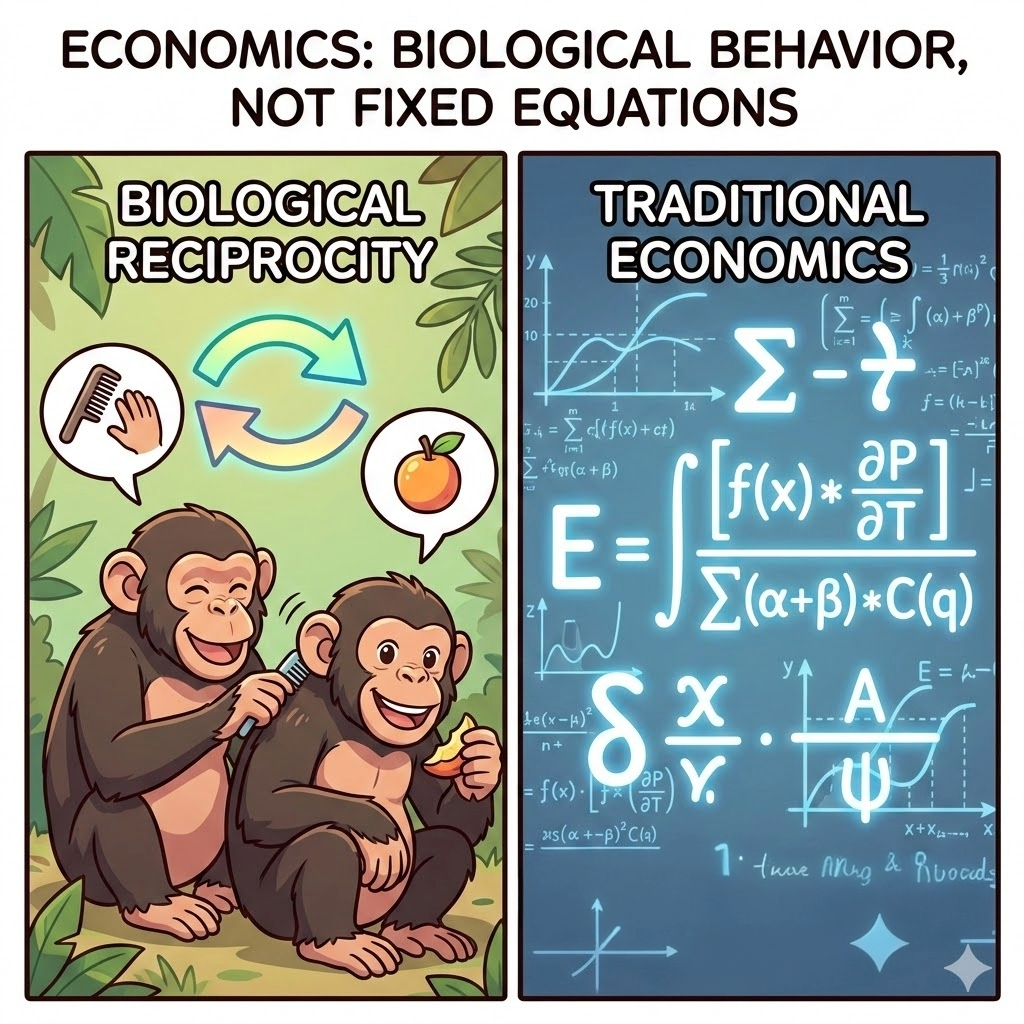

Early Societies
Reciprocity operated as a biological social behavior—holding early communities together through memory,
obligation, and bonds, rather than barter.

Chimpanzees
Reciprocity is robust: grooming, food sharing, and coalition support are exchanged based on past
interactions and bonds.

Developmental Psychology
Infants display reciprocity spontaneously—tracking helpers, remembering favors, and expecting returns
without instruction.
For centuries, the story of economics has been told through barter: people without money trading goods directly, and from this, markets and money supposedly emerged.
But think about your own life. When you don’t use money with friends, family, or colleagues, you almost never barter. You don’t trade an apple for a banana. Instead, you help, share, and rely on reciprocity over time.
This is the real root of exchange: not isolated swaps of value, but social interaction—recognition, memory of relationships, and expectations of return.
This project reframes economics from the ground up: not as an abstract system of transactions, but as a cognitive and social behavior.
Early human societies were not held together by barter. They were sustained by reciprocity—giving, returning, and remembering. Exchange was bound up with memory and social ties: who helped you before, who you owe, and what kind of relationship you share. This is not abstract calculation; it is biological behavior.
Crucially, reciprocity is not unique to humans. Many animals—from chimpanzees to monkeys and even bats—show reciprocal helping and exchange-like interaction. In controlled experiments, nonhuman primates exhibit the same kinds of economic biases seen in humans:
These continuities show that the foundations of economics are not invented institutions, but shared biological behaviors that long predate markets and money.
The textbook story begins with barter: people trading goods directly until money arrived. But barter is fragile and unsustainable as a foundation for economic life. It fails in practice for several reasons:
By contrast, reciprocity avoids these traps. It works through memory, relationships, and flexible return over time—a social credit system that reduces friction and sustains long-term cooperation.
Traditional economics starts with an assumption: people are rational agents, guided by utility functions, and interacting until they reach equilibrium. For centuries, this framework has shaped the way economists describe choice and exchange.
But these are abstractions, not mechanisms. They draw neat curves on paper, yet explain nothing about how real humans—or other animals—actually decide, cooperate, or exchange. Equilibrium, too, is a static construct that cannot capture the open-ended, dynamic nature of reciprocal interaction.
This project moves past that scaffolding. We replace rational-agent models with a cognitive and agentic foundation of exchange—built on recognition, memory, reciprocity, and the social dynamics that make economic life possible.
Despite centuries of economic inquiry, the origins and underlying mechanisms of economic behavior remain unclear. Accounts of economic origins often begin with Adam Smith’s narrative of barter, while economic theory more broadly has developed from assumed preferences and optimizing agents rather than from an empirical account of how economic behavior first emerged. Yet findings from behavioral economics show that human behavior frequently departs from these assumptions.
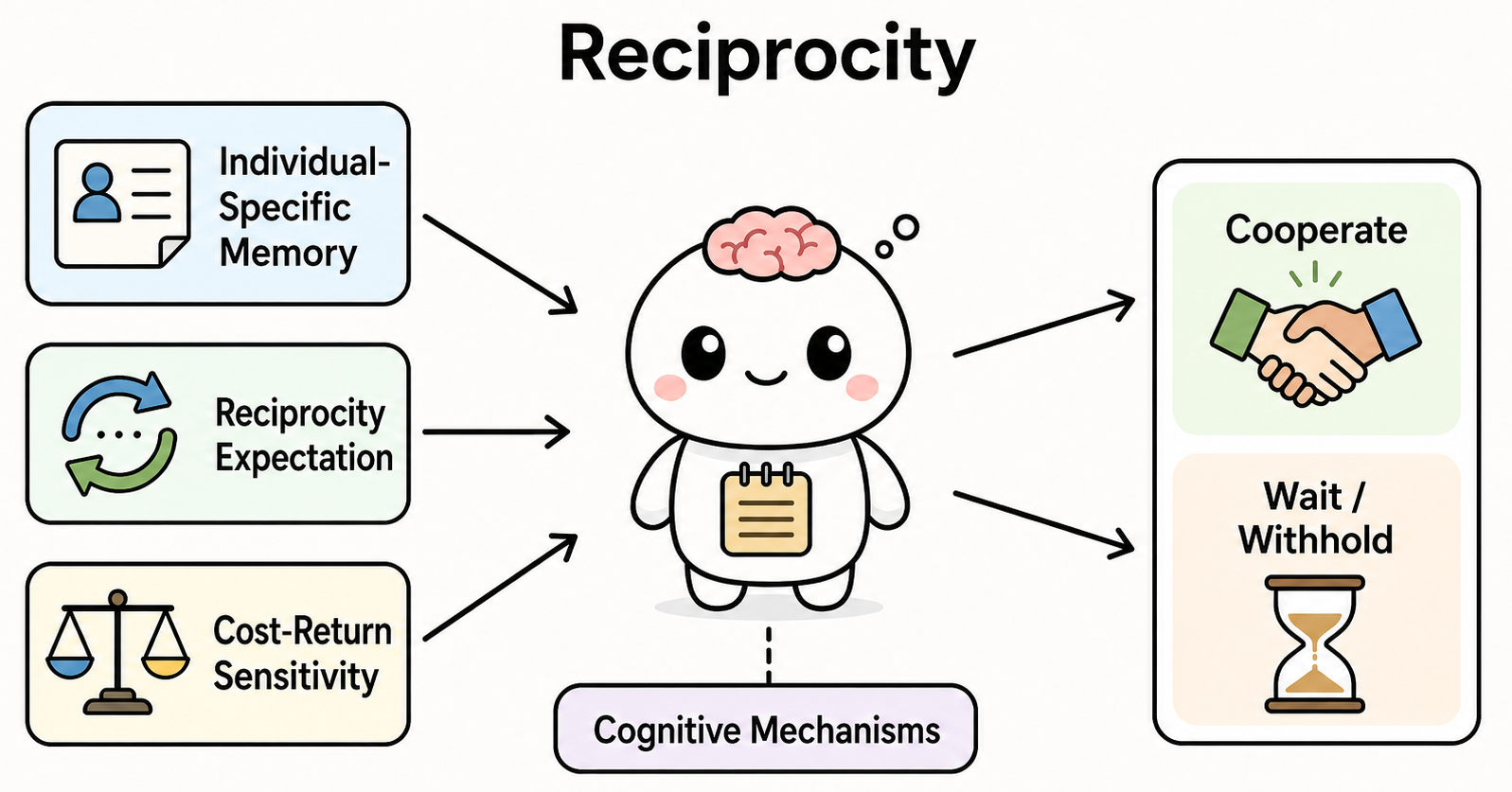
Here we challenge the barter-first narrative and argue that economic exchange originated in reciprocity, a basic biological form of social interaction. Drawing on evidence from anthropology, primatology, and developmental psychology, we specify how reciprocity gives rise to economic exchange by identifying three cognitive mechanisms underlying reciprocal exchange: individual-specific memory, reciprocity expectation, and cost-return sensitivity.
Together, these mechanisms provide a unified, empirically grounded foundation for economic exchange and a common basis for understanding broader forms of cooperation and the emergence of more complex economic arrangements.
Despite centuries of theory, the true origin of economic exchange remains underspecified. Most models assume institutions, utility, or symbolic trust—but say little about how these systems emerge from real social behavior.
This missing foundation isn’t just a theoretical gap. It prevents us from building artificial agents that behave socially in a stable, scalable way. Without grounding in memory, expectation, and behavioral payoff, trust becomes just a label, not a mechanism.
By modeling exchange as something that emerges from basic cognitive capacities—not something imposed by rules—we open a new path for simulating how institutions form, rather than assuming they already exist.
@misc{diau2025cognitivefoundationseconomicexchange,
      title={The Cognitive Foundations of Economic Exchange: A Modular Framework Grounded in Behavioral Evidence},
      author={Egil Diau},
      year={2025},
      eprint={2505.02945},
      archivePrefix={arXiv},
      primaryClass={cs.CY},
      url={https://arxiv.org/abs/2505.02945},
}