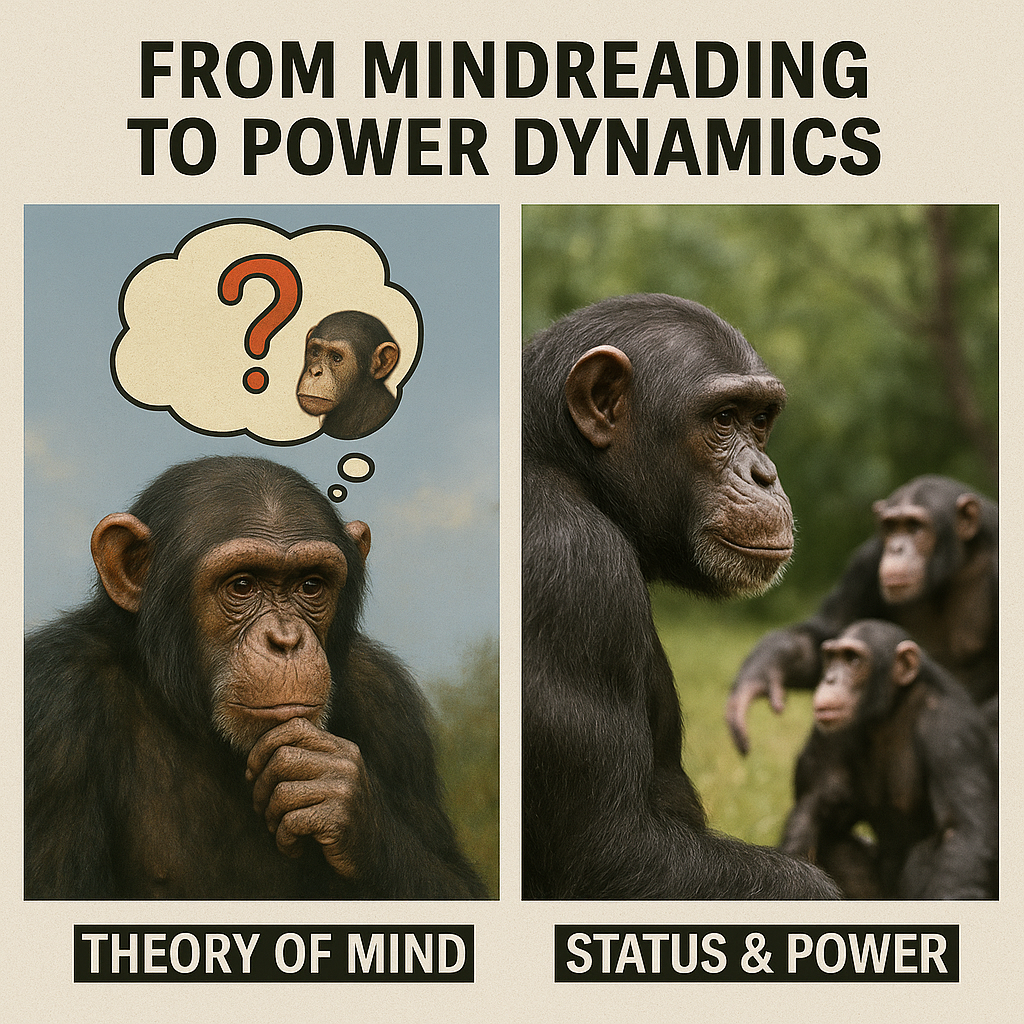

Failed Tasks in Animals
Animals consistently fail Theory of Mind tasks, leading many
to claim ToM is uniquely human. But these
tasks may be asking the wrong question.

Debated Minds, Clear Power
Theory of Mind research began with chimpanzees, yet
evidence remains weak and highly debated. In contrast, power behavior in chimps has never been in
question.

Fragile Inference in Humans
Human social inference is context-dependent, fragile, and
prone to error, in part because mental states are inherently unobservable—many people don’t even know what
they believe themselves.

Power Over Mindreading
Across species, power dynamics explain social behavior better
than belief inference. Mental inference in animals is hard to detect—but power tracking is always clear.
Social cognition is often centered on empathy—the capacity to feel or understand others’ emotions. But in many goal-driven interactions—like negotiation, interviews, or sales—empathy offers limited utility. Even if you pick up fragments of the other person’s internal state, that information is often partial, ambiguous, or unreliable—and rarely enough to influence the outcome.
ToM assumes we can access others’ mental states, but in reality, these states are unobservable and unstable. People often don’t know what they believe, change their minds without noticing, or deliberately hide their motives. This makes social inference less about accurate understanding, and more about inference based on memory and loosely related information.
To build a more realistic model of social cognition, we must shift from internal simulation to external structure: not “what is she thinking?”, but “who adjusts to whom?”, “who can afford to act?”, and “who holds leverage?”.

Four claims, four failures — clear across psychology, behavior science & neuroscience.
Obvious — yet ignored
Core evidence is fragile
Multifunction TPJ
Power is the true constant
Theory of Mind (ToM)—the capacity to infer others’ mental states—has long been treated as a cornerstone of social cognition. Yet its conceptual boundaries and mechanistic foundations remain vague, and its empirical robustness is less secure than often assumed.
This tension is especially striking because ToM originated in comparative work on chimpanzees, even though chimpanzee social life is best known for power-related behavior. The same problem appears in humans: lie detection—arguably the most iconic real-world false-belief task—reveals an accuracy of only about 54\%, barely above chance. Across humans and other social species, mental-state inference is inconsistent, context-dependent, and error-prone, indicating that “mindreading” is better understood as pattern-based social inference rather than a dedicated cognitive module. By contrast, status recognition and power-relevant behavior are robust, contextually stable, and consistently observed across species.
We therefore propose reframing social cognition as the tracking of status and the navigation of power dynamics rather than hidden mental-state inference. This reframing provides an empirically grounded account of social cognition that better reflects social interaction in real-world settings.
Power — the actual relative position in the system, determining one’s true capacity to influence outcomes.
Minimal & Unified
Status — the perceived relative position in the system, reflecting how others collectively see and treat that capacity.
Minimal & Unified
| Domain | Representative Behaviors |
|---|---|
| Coordination and Alignment | Leadership, delegation, mediation, group conformity |
| Attention and Visibility Management | Success, reputation signaling, social comparison, self-esteem |
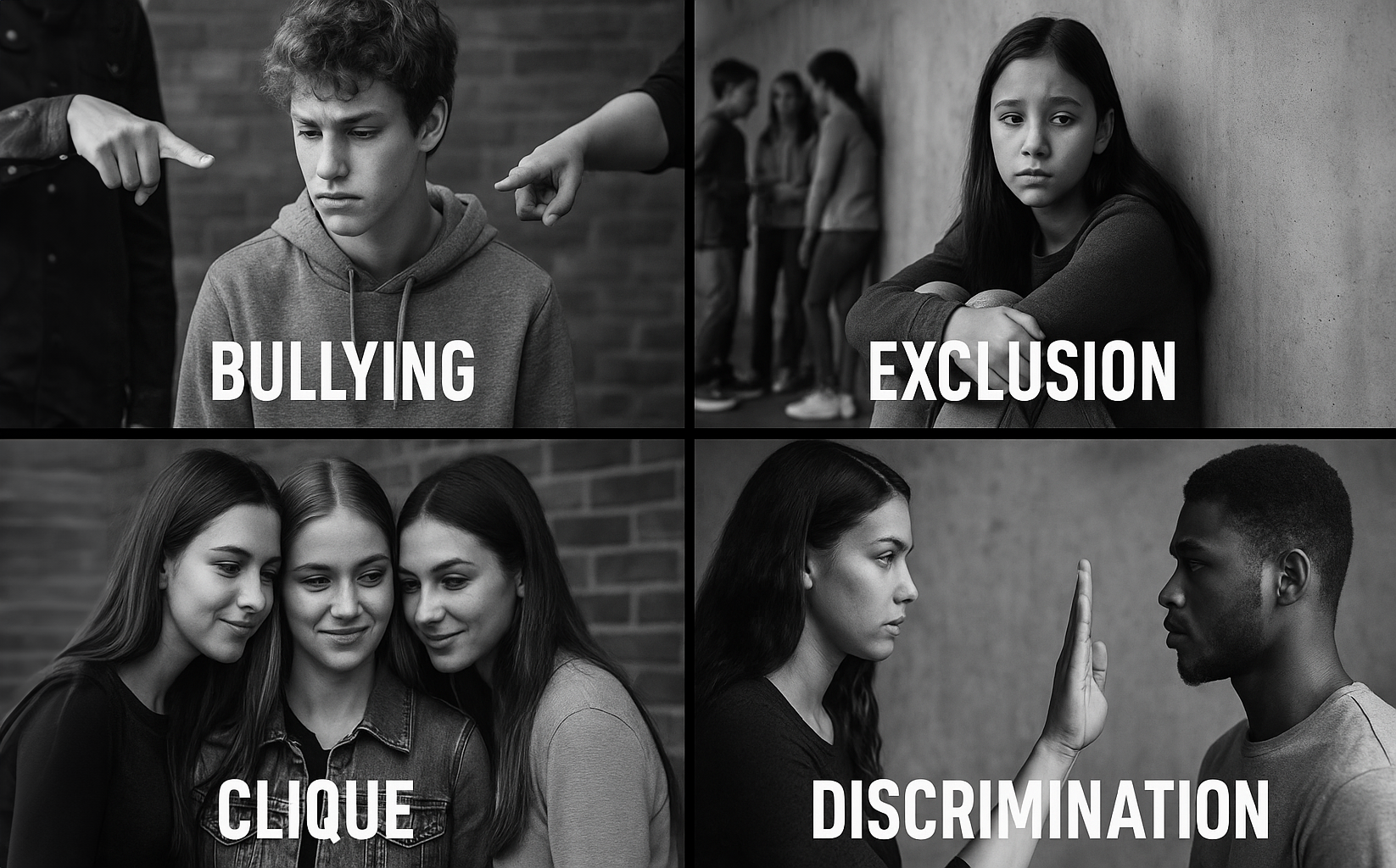
| Access and Boundary Regulation | Inclusion and exclusion dynamics, social stratification, discrimination, gatekeeping |
| Norm and Value Stabilization | Group identification, labeling, virtue signaling, value affirmation |
| Influence and Contingency Management | Influence, persuasion, manipulation, bullying |
Relative position serves as the unified structural backbone of social behavior—from coordination to influence.
For decades, we've built our theories of social intelligence on the idea of "mindreading"—that humans (and maybe machines) infer others’ beliefs to cooperate.
But the evidence doesn’t add up: animals fail ToM tests, humans misread each other all the time, and power dynamics often predicts behavior better than belief inference.
What if social cognition isn't about beliefs at all—but about power? Not internal beliefs, but external structure—who leads, who yields, who shapes the outcome.
Rethinking ToM around power shifts our focus from imagined minds to real, observable social dynamics. It changes how we study cognition, how we model agents, and how we explain the fabric of social life.
@misc{diau_2025_16847667,
  author       = {Diau, Egil},
  title        = {Rethinking Social Cognition: Power, Status, and the Myth of Mindreading},
  month        = aug,
  year         = 2025,
  publisher    = {Zenodo},
  doi          = {10.5281/zenodo.16847667},
  url          = {https://doi.org/10.5281/zenodo.16847667},
}